Every few years, an investor or Finance Committee may rewrite their Investment Policy Statement (IPS). It can be a way to express your values. For example, it’s where many have chosen to divest from fossil fuels. It’s also often where you set “the mandate” for your Investment Advisor / Consultant / OCIO.
Key Components might include:
Objectives: Clearly state investment goals.
Risk Tolerance: Define the acceptable level of risk.
Asset Allocation: Specify the mix of assets.
Diversification: Spread risk across assets.
Performance Benchmarks: Set evaluation standards.
Liquidity: Address short-term cash needs.
Constraints: Identify any restrictions.
Ethical Screens: Exclude/include investments based on religious principles.
Socially Responsible Investments: Support companies with positive practices.
Avoidance of Sin Industries: Exclude morally objectionable sectors.
Proxy Voting Guidelines: Vote in line with ethical considerations.
Sustainability Metrics: Consider sustainability in investment evaluation.
A leading edge IPS? Why or Why not?
A friend & collaborator just sent me the The Russell Family Foundation’s IPS that she felt was an inspiring example of what an IPS can be.
Here’s an excerpt of what she wrote me:
“They categorize investments as “Investment Portfolios” (page 7). Have you seen this approach elsewhere? They have four asset categories that represent distinct functions for the assets, yet the portfolio is managed collectively as a pool. To me, this makes sense and would help prioritize the mission when making investing decisions rather than asset class. It’s accomplishing the same thing but through the prioritization of mission.
My response:
I do think what you’re pointing to with the Stability, Growth, Diversified, and Aspirational Portfolios (page 7) is a much better way to categorize one’s asset allocation / portfolio than the traditional asset classes — and allows for more impact, responsible decision-making within each.
For example,
I could imagine CDFIs being an impact injection into the “Stability Portfolio”.
And Impact private equity being part of the Growth portfolio.
Obviously the Aspirational portfolio is the exciting stuff. I loved how they named both catalytic and scaling of funds as their two focus areas.
I guess I wasn’t wow’d by only 5% to Aspirational… but perhaps this is where leaders in the field are at right now?
I guess this is a major question we’ve been trying to ask ourselves recently:
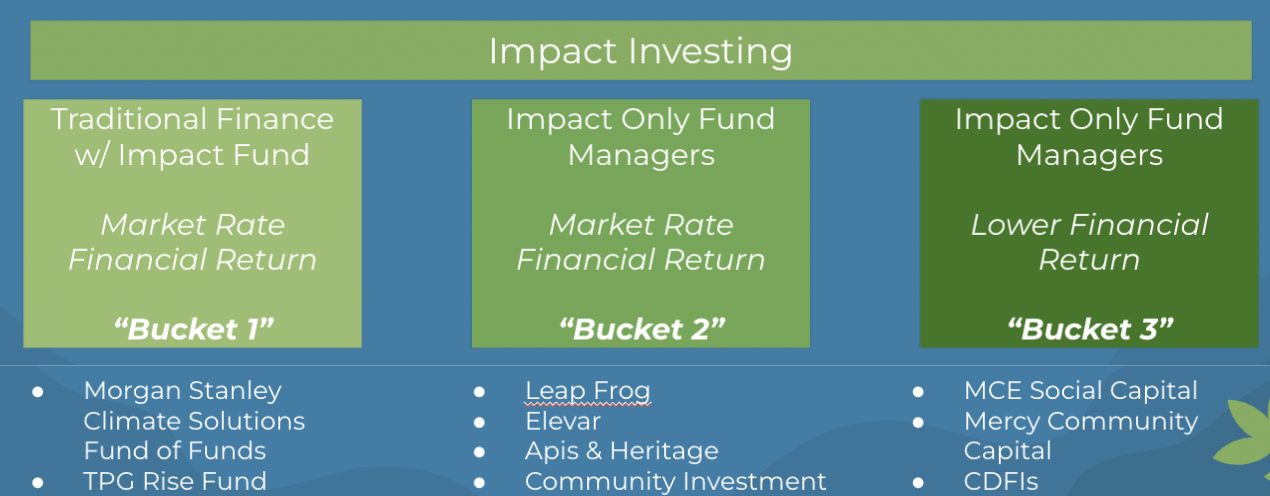
What are leading impact investors doing in terms of Bucket 2 and Bucket 3 impact investments?
Are there Catholic organizations that have 5% in “Bucket 2 and 3” like TRFF/Russell? (I have hunch there are 2… maybe 3 or 4…?
Are there any Catholic asset holders that have >10%?
Are there 20 that have 1% in this “Aspirational Portfolio” bucket?
Are any investors trying to make the Aspirational Portfolio 25 or 50% of their portfolios?
One hope for 2024, is that we do an “assessment” of our workshop alumni and CIIC members to get a better handle on this.
Do you have any sense of other people doing this kind of research?
Or who might have a sense of the field like this?
Liquidity
Back to the Russell Family IPS, I especially appreciated what they noted about Liquidity
Our general guideline is to have a maximum of 25% of our assets in illiquid investments (investments with more than 12 months’ notice before they can be redeemed). Liquidity is evaluated on a total portfolio basis, not by individual asset class.
This felt like a progressive view to me… but I haven’t been looking too closely.
Emerging Managers
One of the things that also surprised me (not in good way) was this:
an Emerging Manager Allocation of no less than 5% of the portfolio across all asset classes.
5% felt low to me. But perhaps this is the current state of play?
Or does it just indicate how few investors / foundations have actually been prioritizing looking for Black / Women / Emerging Managers?
I would hope you could find at least 10% across each area … and especially in the “Aspirational” section.
Fiduciary Duty
I’ll end on a high note. One of the parts that stood out to me was the naming of intergenerational equity questions as part of fiduciary duty.
All parties with decision-making authority are fiduciaries of TRFF and are obligated to act in TRFF’s best interest. Washington State adopted the Uniform Prudent Management of Institutional Funds Act (UPMIFA), establishing specific governance standards for private foundations such as TRFF.
TRFF recognizes that the foundation’s financial health and the impact of our investments are part of our fiduciary duty. This includes careful stewardship of our assets beyond a duty of care for financial performance. We also account for intergenerational equity by considering the future impact of decisions TRFF makes today
I’m grateful for the sharing of this IPS — and I hope it can guide others to do similar… in the spirit of learning and improving together.